What to do after a car accident — the order matters
Short version: in the first 48 hours, do these four things in this order — (1) photograph the scene before any car is moved, (2) note the police report number, (3) see a doctor even if you feel fine, (4) do not give a recorded statement to the other driver's insurer without thinking it through. The order is what determines whether you have documentation later or not.
That's the framework. The rest of this page explains each step, three common traps that wreck claims, and a single question that tells you whether you actually need a lawyer.
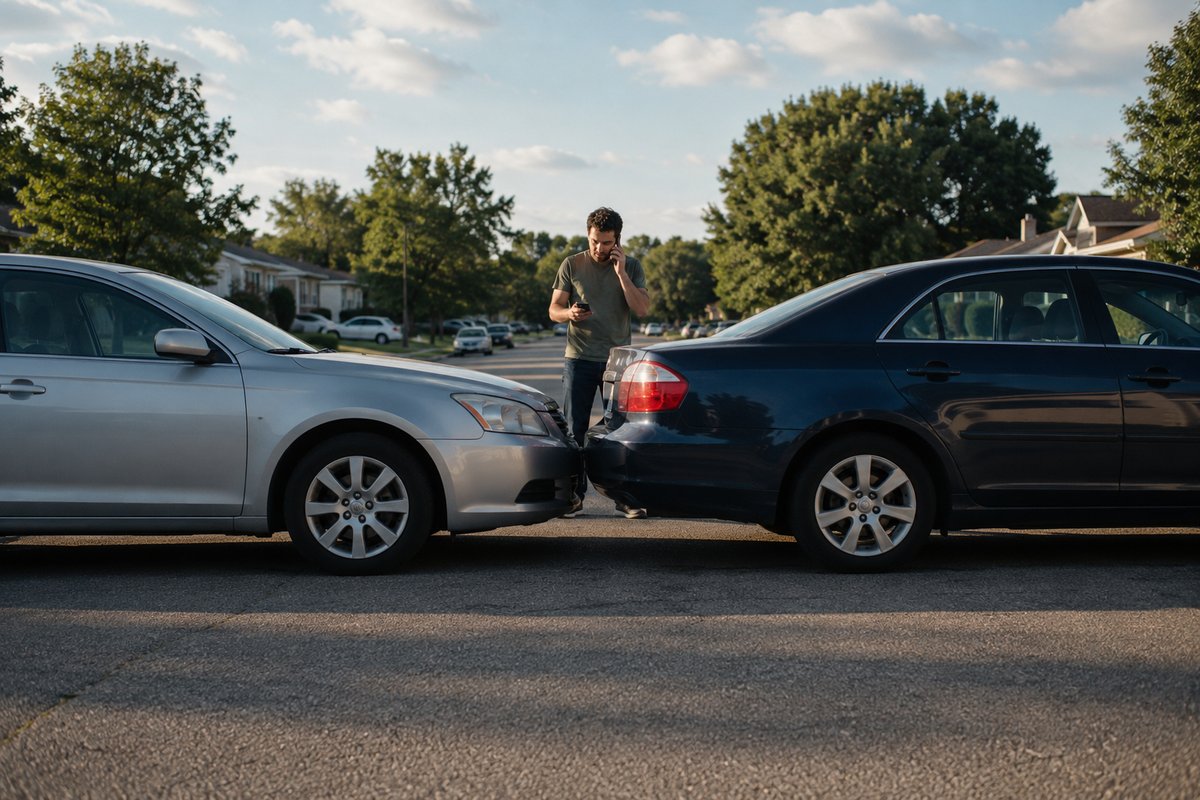
Step 1 — Photograph the scene before any car is moved
A common pattern: drivers move vehicles to the shoulder "to be safe" before taking pictures. Insurance adjusters and accident reconstructionists then can't determine fault from vehicle positioning. Take photos from multiple angles before anything moves; if the cars must be moved for safety (a freeway, an active hazard), photograph the original positions first.
What to capture: both license plates, both VINs (visible through the windshield), damage to both vehicles, road conditions, skid marks, traffic signs visible from the scene, the other driver's insurance card, and the other driver's driver's license.
Step 2 — Get the police report number
You don't need the full report immediately — you need the report number, which the responding officer will give you. With that number, you can usually order the full report through your state's police records portal a few days later. Without it, retrieval can take hours of phone calls.
If police don't respond (some jurisdictions decline to dispatch for minor property-damage accidents), most states allow you to file a self-report. The NHTSA maintains links to state crash-reporting requirements.
Step 3 — See a doctor, even if you feel fine
Adrenaline can mask soft-tissue injuries for hours or days. Delayed-onset symptoms after motor vehicle collisions — particularly whiplash, concussion, and back/neck strain — are well documented by the CDC's traumatic brain injury resources and standard emergency-medicine references. Get evaluated within 24 hours; "cleared by a doctor" is a good outcome, "no medical record from the day of the accident" is a documentation gap that's hard to close later.
Step 4 — Be deliberate about recorded statements
Within a day or two, the other driver's insurance company will likely call and ask for a "quick recorded statement." You are not legally required to give one to the other driver's insurer. The National Association of Insurance Commissioners (NAIC) publishes consumer guidance on insurance claim disputes.
What you can say: "I'm gathering information and will provide a written statement after I've reviewed everything." That is a complete and reasonable answer. You generally are obligated to cooperate with your own insurer under your policy's cooperation clause — that's a different conversation.
Three traps that wreck most claims
| Trap | What people do | What to do instead |
|---|---|---|
| "It's just a fender-bender" | Skip the police report, exchange info, drive away | Call the non-emergency police line. A documented report exists. |
| "I'll just take the quick settlement" | Sign a release for a few hundred dollars within days | Wait at least 30 days. Medical bills can surface late. Releases are usually binding. |
| "My insurance will handle everything" | Let your own insurer subrogate without input | You can still pursue the at-fault driver's insurer for what yours doesn't cover. |
The one question: do you need a lawyer?
The cleanest filter: did anyone seek medical treatment?
- No medical treatment, only vehicle damage — usually handled through insurance. The economics of a personal-injury contingency arrangement (typically 33% of recovery, per standard ABA-published ranges) rarely favor a pure property-damage claim.
- Any medical treatment, even one urgent-care visit — talk to a personal injury attorney. Most do free initial consultations for accident cases.
- Long-term injury, ongoing treatment, or lost wages — do not negotiate alone with an insurance adjuster. This is the case the contingency model exists for.
Frequently asked questions
Should I post about the accident on social media?
No. Insurance defense investigators routinely review claimants' social media. Anything from "I'm okay, just shaken!" to a photo of you smiling at a friend's birthday can be used to argue against an injury claim. Stay quiet on social channels until any claim is resolved.
How long do I have to file?
The statute of limitations varies by state, claim type, and a few exceptions (the discovery rule, notice-of-claim deadlines against government entities). The statute of limitations calculator on this site provides a starting estimate.
The other driver doesn't have insurance. Am I stuck?
Not if you have uninsured / underinsured motorist coverage (UM/UIM) on your own policy. This is exactly what UM/UIM is for. The Insurance Information Institute explains how it works. If you don't have it, consider adding it at your next policy renewal — it's typically inexpensive and pays for itself the first time you need it.
This is general information, not legal advice
Your situation has facts we don't know about. For an actual legal opinion specific to your case, consult an attorney licensed in your state.